
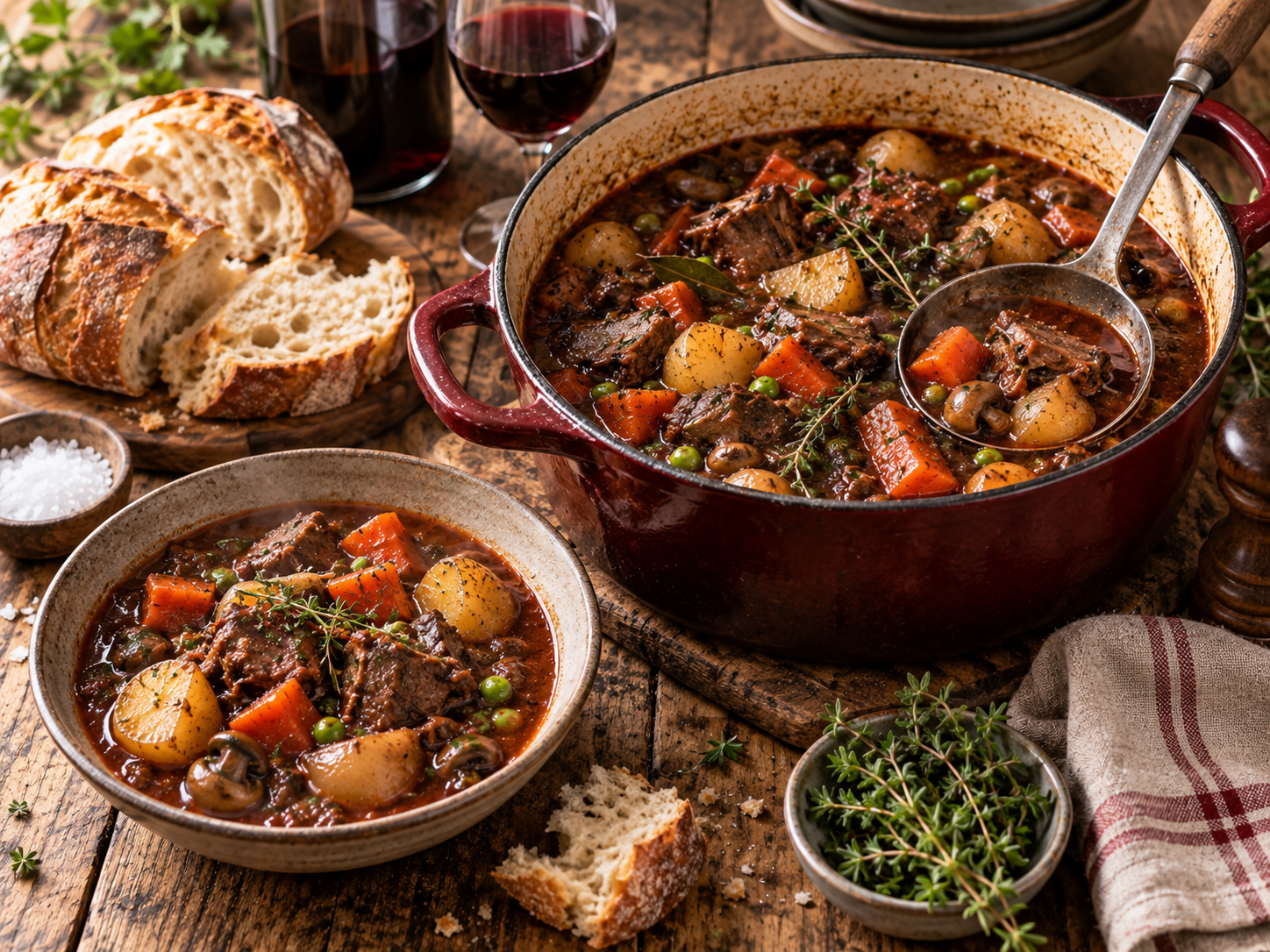
Ingredients
- 1-1/2 to 2 lb goat meat, cut into 1-1/2-inch chunks (680 to 905 g)
- 1-1/2 tsp kosher salt (9 g)
- 1/2 tsp black pepper
- 3 tbsp (23 g) all-purpose flour
- 2 tbsp olive oil (27 g)
- 1 large yellow onion, chopped
- 2 celery stalks, sliced
- 3 cloves garlic, minced
- 1 tbsp tomato paste
- 1 cup dry red wine
- 2-1/2 cups beef stock, plus 1/4 to 1/2 cup more if needed
- 1 tbsp Worcestershire sauce
- 1 tsp dried thyme
- 1/2 tsp dried rosemary, crushed between your fingers
- 1 bay leaf
- 3 medium carrots, cut into 1-inch pieces
- 1 lb Yukon Gold or red potatoes, cut into 1-1/2-inch chunks (455 g)
- 8 oz mushrooms, quartered (optional, but recommended) (225 g)
- 1/2 cup frozen peas (optional)
- 1 tbsp butter (optional, for finishing) (14 g)
Instructions
-
Prepare the goat — about 10 minutes
- Pat the goat dry. Season with the kosher salt and black pepper. Sprinkle with the flour and toss until the pieces are lightly coated.
-
Brown the meat — 12 to 15 minutes
- Heat a Dutch oven or other heavy pot over medium-high heat. Add the olive oil. Brown the goat in 2 batches, about 3 to 4 minutes on the first side and another 2 to 3 minutes while turning, until well browned rather than gray. Transfer the browned meat to a plate.
-
Build the base — about 8 minutes
- Reduce the heat to medium. Add the onion and celery and cook for 5 minutes, stirring occasionally. Add the garlic and cook for 30 seconds. Stir in the tomato paste and cook for 1 1/2 to 2 minutes, stirring, until it darkens slightly.
-
Reduce the wine — 4 to 5 minutes
- Pour in the red wine and scrape the bottom of the pot thoroughly to release the browned bits. Bring to a simmer and cook uncovered for 4 to 5 minutes, until the wine has reduced by roughly one-third. This mellows the wine and integrates it into the sauce.
-
Braise the goat — 1 hour 45 minutes
- Return the goat and any accumulated juices to the pot. Add the beef stock, Worcestershire sauce, thyme, rosemary, and bay leaf. The liquid should almost cover the meat; add another 1/4 to 1/2 cup stock or water if necessary. Bring just to a gentle simmer, cover, reduce the heat to low, and cook for 1 hour 45 minutes. Check every 30 to 40 minutes to make sure the pot is maintaining only a very gentle simmer rather than a hard boil.
-
Add the vegetables — 45 to 60 minutes
- After the goat has cooked for 1 hour 45 minutes, add the carrots, potatoes, and mushrooms if using. Stir gently, cover, and cook for 45 minutes. Test the goat with a fork. If it pulls apart easily, it is ready; if it is still chewy, cook another 15 to 30 minutes. Goat varies considerably by cut and animal, so tenderness rather than the clock is the final test.
-
Finish — about 5 minutes
- Remove the bay leaf. If using peas, stir them in and cook for 3 to 4 minutes. Taste and adjust salt and pepper. For a richer sauce, stir in the butter just before serving. If the gravy is too thin, simmer uncovered for 5 to 10 minutes; if it is too thick, add a splash of beef stock.
Notes
Wine: Use a dry, drinkable red such as Cabernet Sauvignon, Merlot, Pinot Noir, or Cotes du Rhone. Do not use cooking wine.
Serving: Serve with crusty bread.
Make ahead: For the best texture and flavor, make the stew a day ahead. Cool, refrigerate, and reheat gently the next day.
Leftovers: The flavor improves noticeably after an overnight rest in the refrigerator.
Two-day version
This stew is especially good made a day ahead.
Cool it properly
- Remove the bay leaf.
- Let the stew stand uncovered for 15–20 minutes, until it stops actively steaming.
- Transfer it to shallow containers, ideally about 2 inches deep or less, and refrigerate promptly.
- For a large batch, set the container in an ice-water bath and stir occasionally to speed cooling.
The next day
- Once chilled, remove most of any heavy solid fat layer, but leave a thin layer for flavor.
- Reheat gently in a saucepan or Dutch oven over low to medium-low heat for about 15–20 minutes, stirring every few minutes.
- If the stew has thickened too much, add 2–4 tbsp beef stock or water.
- Once hot throughout, let it barely simmer for about 5 minutes.
- Reheat leftovers to 165°F / 74°C in the center.
- Avoid a hard boil so the goat and potatoes stay intact.
For the best natural gravy
- Simmer uncovered for the last 10–15 minutes to reduce the sauce.
- Mash 2–3 potato chunks into the broth.
- If it still needs thickening, mix 1 tbsp cornstarch with 1 tbsp cold water until smooth.
- Stir the slurry into the gently simmering stew and cook for 1–2 minutes.
- If needed, add only another half batch of slurry.
Before serving
Taste the stew again. If it seems a little flat, add either:
- a pinch of salt, or
- 1–2 tsp red wine vinegar
Add only enough vinegar to brighten the flavor, not make the stew sour.
Why it tastes better the next day
Overnight, the wine, stock, herbs, meat juices, vegetables, and gelatin have time to meld. The gelatin firms as the stew chills, then melts back into the sauce during reheating, giving the day-two stew a richer flavor and texture.